Scenting Rooms with Melissa Oil: Diffusers to Sprays
Open the windows in spring and a room-scenting plan changes. Fresh air carries vapour away faster, and the instinct is to add more drops to keep up. A better move is to pick the right method first, because melissa oil has published limits for most room formats, and the water-based diffuser most people have in mind is the one format with no figure at all.
Melissa Essential Oil
Our own Melissa Essential Oil, in sizes from 0.5 oz to bulk.
From $23.99
Shop Now →Start with the format
IFRA, the fragrance industry's self-regulation body, sorts products into categories and sets maximums for each material in each one. Its limits bind fragrance suppliers more than a person at a kitchen table, yet they are the clearest public statement of where assessors draw the line. IFRA's guidance document says which products fall into which category, and the 51st Amendment gives the figures for melissa oil and for its main components, citral and citronellal.
| Spring method | IFRA category | Melissa oil | Citral | Citronellal |
|---|---|---|---|---|
| Water-based ultrasonic diffuser | Not named in the guidance | No figure | No figure | No figure |
| Plug-in, electrical, sachet, incense | 12 | No restriction | No restriction | No restriction |
| Reed diffuser, pot-pourri, hard surface cleaner | 10A | 4.2% | 1.2% | 1.4% |
| Manual air freshener spray | 10B | 4.2% | 4.2% | 2.3% |
Reed diffusers land in the stricter 10A because of handling the soaked reeds, and IFRA has said it plans to review these categories, so read the table as current rather than final. The absence of a number for water diffusers is a gap in the guidance, not an all-clear.
In a diffuser, time matters more than drops
For a water-based diffuser the best guidance we found concerns time. Robert Tisserand says intermittent diffusion, about 30 to 60 minutes on and then 30 to 60 minutes off, is "much more effective, as well as being safer, than continuous diffusion", and that very low levels, "so the essential oil is barely noticeable", are fine anywhere (Tisserand Institute). The page gives no drop counts. Our suggestion is gentle: a single drop in the diffuser beside lavender, or one or two drops in a blend, following your device's instructions.
The American Lung Association takes a more cautious line: adding anything, essential oils included, to the air you breathe is not recommended, so ventilate if you do diffuse, and people with asthma or COPD should speak with a healthcare professional first (American Lung Association). An open window helps there. It also means a drop count tuned for a shut room will seem to vanish, and the sensible response is a smaller dose for longer, with the breeze doing the diluting.
If you share your home with a cat, the Tisserand Institute says diffusing is generally fine with good ventilation, small amounts, limited sessions and a cat that can leave the room (Cats and Essential Oil Safety). ASPCA Pro advises against diffusers where birds live and suggests avoiding them for pets with breathing trouble (ASPCApro). Anyone who is pregnant should start with what is published on pregnancy.
A reed diffuser, worked out
A reed diffuser is where a number exists. In Category 10A the melissa oil figure is 4.2%, but the citral figure is 1.2%, and melissa oil is rich in citral. Without a GC-MS report for your bottle, the cautious reading is to assume the worst case: if all of the oil counted as citral, the oil would be capped at 1.2%. That ceiling holds whatever the oil's citral share turns out to be. Citronellal, at up to about 20% of the oil in published analyses, never becomes the limiting figure.
As arithmetic, 1.2% of 100 g of diffuser liquid is 1.2 g of oil. With our batch's relative density of 0.888 and about 20 drops per millilitre, that is roughly 27 drops. Treat it as an upper bound, not a target, and begin well below it. The base liquid and reeds come from a craft supplier, since we sell the oil only. If you scent with other lemon-note oils such as lemongrass or litsea, their citral counts toward the same limit.
Sprays and cleaning
A manual room spray falls in 10B, with a higher citral figure of 4.2%. Oil and water separate, so a spray needs a suitable base and, if it contains water, a preservative, all from a supplier other than us. Do not carry numbers from one row to another: our pillow spray article covers a different category with much tighter citral and citronellal figures. We make no cleaning claims for the oil.
Let the weather help
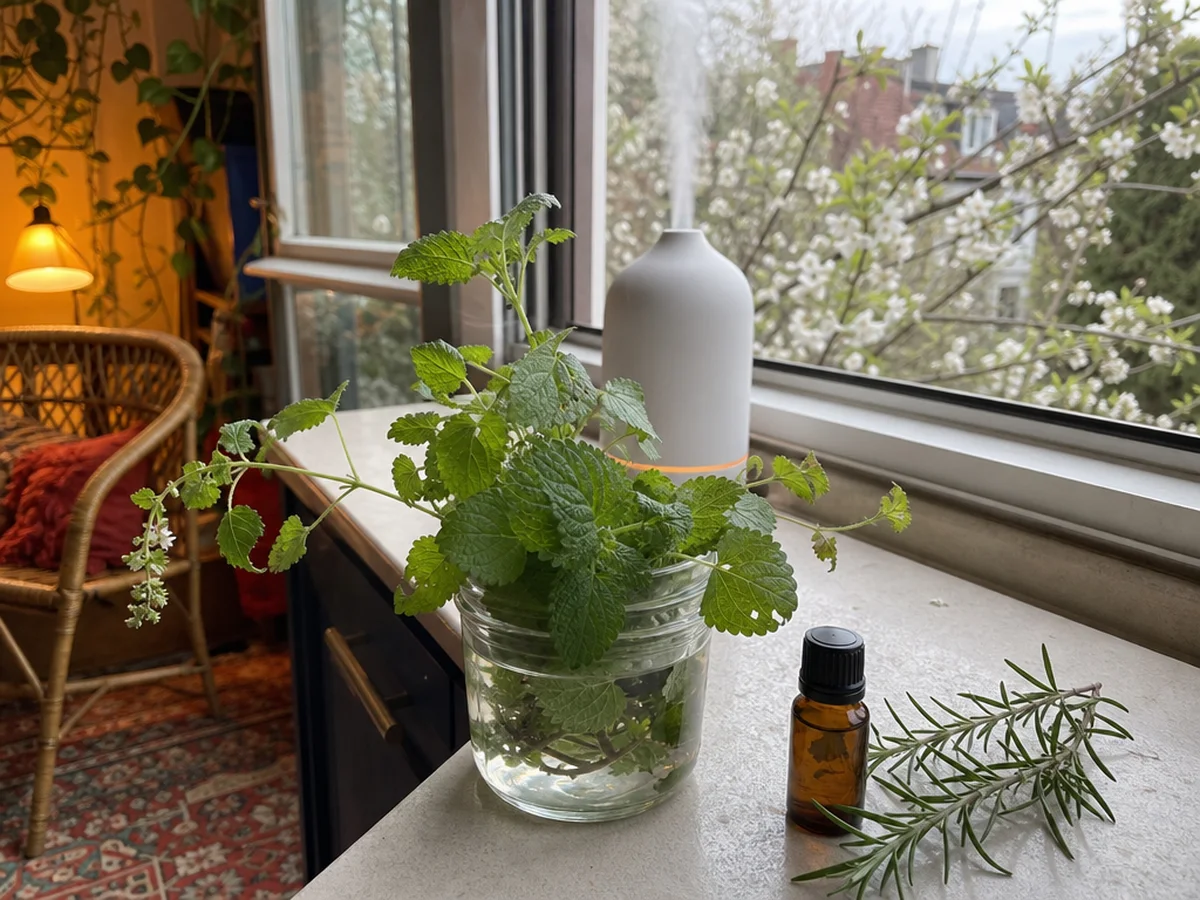
Spring air is a gift to a delicate oil. On a still afternoon a very light touch is enough, and on a breezy one a single drop in the diffuser, a few steps from the open window, may do more than a heavy hand. Move the diffuser around the room across a few days, near a window, by a shelf, in a corner, and notice where the lemon-and-herb note reaches you without crowding you. Wherever it sits, keep it where pets and children cannot knock it over.
Pairing for an airy room
A review of oils in perfumery describes bergamot as a top note with a "light, delicate citrus-like scent" lasting 5 to 10 minutes, perhaps 30, and lavender as a middle note with a "sweet floral aroma" that can last up to an hour (Sharmeen and colleagues, 2021). Reasoning from those timings, in a breezy room the bergamot fades first and leaves lavender with a little melissa lemon above it. We worked the three-oil version out in our melissa, lavender and bergamot article, and our pairing guide lists other partners. The lavender and bergamot come from another supplier.
In a breeze, pick the format, read its row, and let the clock do more of the work than the dose. A delicate oil asks for a quiet room, so a nearby spot suits it better than a whole house.
Melissa Essential Oil
Melissa Essential Oil from our own shop, in sizes from 0.5 oz to bulk.
From $23.99
Shop Now →Sources & Further Reading
- Guidance for the Use of IFRA Standards. IFRA, 2023. IFRA guidance PDF
- IFRA Standards - 51st Amendment (Melissa oil; Citral; Citronellal). IFRA, 2024. ifrafragrance.org
- Safety guidelines for diffusing essential oils at home. Tisserand Institute. tisserandinstitute.org
- Essential Oils: More Harmful Than Helpful? American Lung Association. lung.org
- Cats and Essential Oil Safety. Tisserand Institute. tisserandinstitute.org
- Are Essential Oils Dangerous to Pets? ASPCApro. aspcapro.org
- Essential Oils as Natural Sources of Fragrance Compounds for Cosmetics and Cosmeceuticals. Sharmeen JB, et al. Molecules, 2021. PMC7865210