What Is in Melissa Oil? Citral, Citronellal and More
Ask three chemists what is in melissa oil and you will get three slightly different answers, and all of them can be right. The oil's character comes from a handful of aromatic molecules, led by the pair that make up citral. How much of each is in a given bottle depends on the plant, the place and the process, which is why we like to talk about melissa in ranges instead of a single recipe.
Melissa Essential Oil
Our own Melissa Essential Oil, in sizes from 0.5 oz to bulk.
From $23.99
Shop Now →The citrus engine: geranial and neral
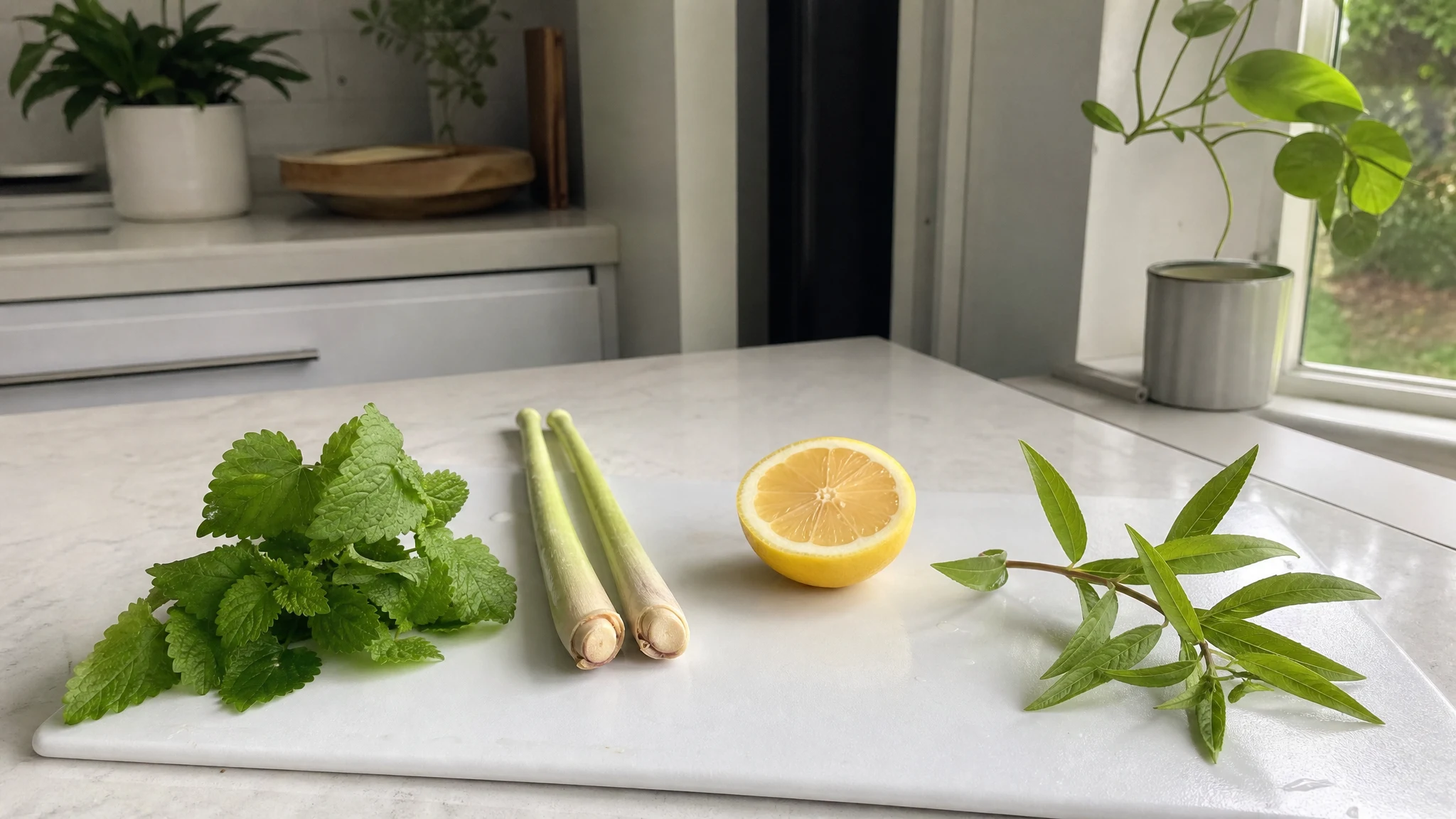
Citral is really two mirror-image forms of the same molecule: geranial and neral. A review of melissa's composition attributes the oil's fresh lemon odor and light yellow color to these citral isomers, together with smaller amounts of citronellal and geranyl acetate (Melissa officinalis: Composition, Pharmacological Effects and Derived Release Systems-A Review). That fits the way we describe our oil: a bright citrus lift over a soft green heart. The green part is harder to pin to a molecule. Heavier compounds such as beta-caryophyllene are present beneath the citrus, but the papers we read do not map specific scents to them, so we will not guess.
Why no two profiles match
The spread is wide. The same review reports geranial from about 6% to 51%, neral from about 4% to 35%, and citronellal from under 1% to about 20% across the oils it surveyed. Two single examples show how different a table can look. Dried leaves from Algiers, distilled in a laboratory, gave geranial at 45.06%, neral at 31.72% and citronellal at 6.42% (Minerals, Essential Oils, and Biological Properties of Melissa officinalis L.), which adds up to a citral total of about 77%. A commercial oil bought in a pharmacy in Ankara in 2025 had geranial at 18.3% and neral at 11.3%, about 30% citral, with beta-caryophyllene at 16.7% (Chemical Profiling and Antimicrobial Prospective of Commercial Essential Oils from Selected Lamiaceae Genera).
Both are genuine analyses of melissa oil, and they differ by more than a factor of two in citral. The review notes that the plant has citral-rich and germacrene D-rich types, and that origin and processing also play a part. The papers vary in country, plant material, laboratory versus commercial distillation and method, so we cannot say which factor accounts for the difference. The practical lesson is that a citral percentage means little without the sample and method behind it. The Ankara authors add that their percentages are relative peak areas, not weights, and are best read as semi-quantitative. If you want to read tables like these, our guide to certificates and GC-MS shows how.
For our own oil, the Certificate of Analysis we publish for one batch lists density, refractive index and optical rotation. If you need a GC-MS composition for a formulation, ask us in writing through the contact page before ordering.
Smelling a bottle with all this in mind
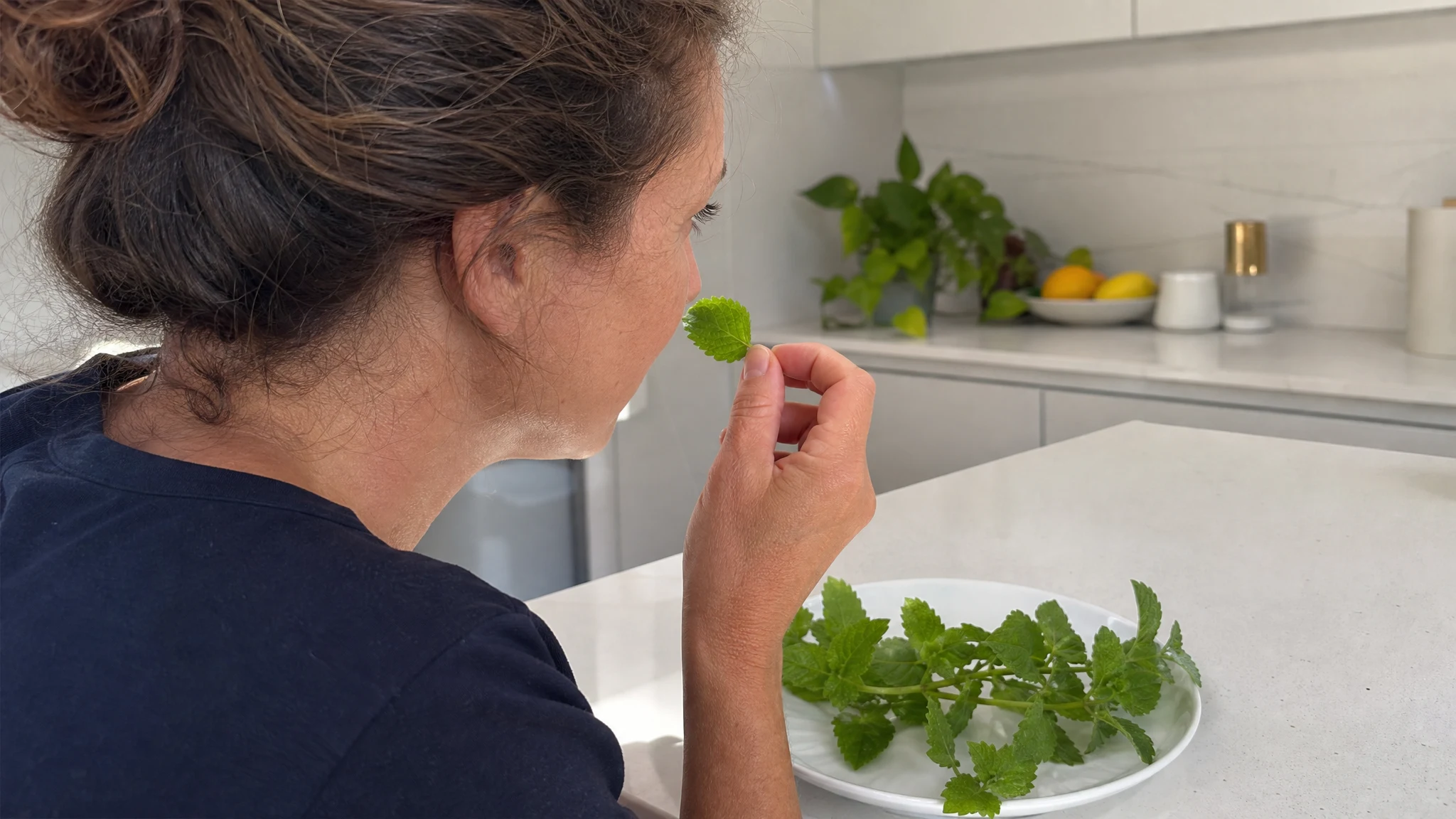
Numbers are one way in. The other is to open the bottle and pay attention. Hold it a little away from your nose first, because a strongly scented oil is easier to read from a distance. Look for the bright lemon first, then, as the first rush settles, something softer and greener underneath. That layering is what we mean by a citrus lift over a soft green heart, and it is the part of melissa that no table captures. Come back to a paper strip after a few minutes and see what stays.
Why citral shapes how little you use
Citral is a well-known fragrance allergen, and it is the compound behind many of the dose limits you see for lemony oils. IFRA, the fragrance industry's standards body, publishes a standard for melissa oil that names dermal sensitization as the concern and allows 0.15% in body creams, oils and lotions (IFRA Standards library). Its separate citral standard sets the same 0.15% for that category, which matters because a high-citral melissa oil can reach that limit with surprisingly little oil.
The arithmetic is simple. At 0.5% melissa oil in a product, an oil that is 29.6% citral contributes about 0.15% citral, which is right at the limit, while an oil that is 76.8% citral contributes about 0.38%, which is more than double it. Same dose, different outcomes, depending on a number that a physical-constants certificate does not give you.
A laboratory study of skin sensitization potential tested commercial oils from six Lamiaceae species in a peptide reactivity assay, a chemistry test that uses no animals or people. Melissa was among the oils classed as moderately reactive and predicted positive (Application of direct peptide reactivity assay for assessing the skin sensitization potential of essential oils). That is a screening result, not a statement about how any person will react, but it fits the picture.
What we recommend
Our own dilution guidance for skin is 0.5% to 2% in a carrier oil, with a patch test first. Because IFRA's figure for leave-on body products is lower, we start at the lower number: for anything left on the skin, we suggest staying at or below 0.15%, which is about one drop in an ounce of carrier, and saving the higher end of our range for products with less contact. Our skin and citral article goes through the comparison, and making a small bottle last shows how far that tiny dose stretches.
It is a pleasant irony of melissa: the molecules that make it so appealing are the same ones that ask you to go lightly.
Melissa Essential Oil
Melissa Essential Oil from our own shop, in sizes from 0.5 oz to bulk.
From $23.99
Shop Now →Sources & Further Reading
- Melissa officinalis: Composition, Pharmacological Effects and Derived Release Systems-A Review, International Journal of Molecular Sciences, 2022
- Minerals, Essential Oils, and Biological Properties of Melissa officinalis L., Plants, 2021
- Chemical Profiling and Antimicrobial Prospective of Commercial Essential Oils from Selected Lamiaceae Genera, Molecules, 2026
- Application of direct peptide reactivity assay for assessing the skin sensitization potential of essential oils, Scientific Reports, 2022
- IFRA Standards library, IFRA